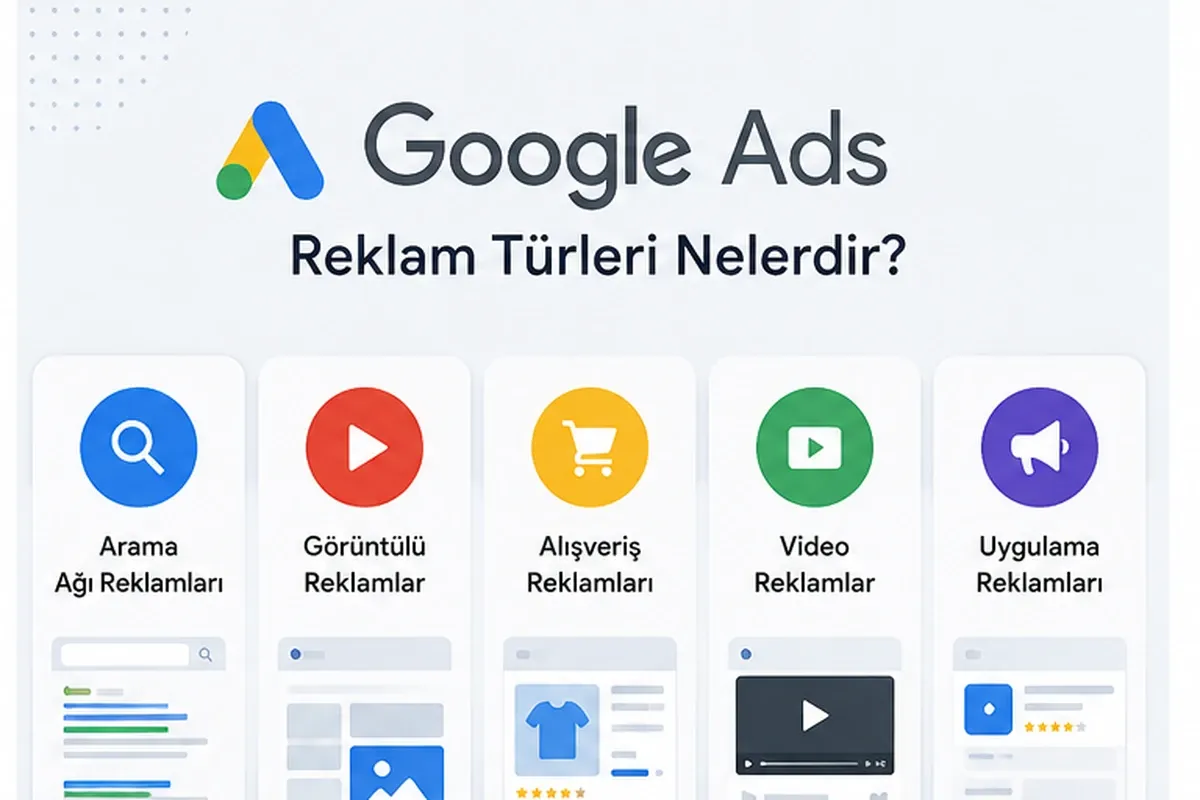
Google Ads campaign types are Search, Display, Video, Shopping, App, Performance Max, and Demand Gen. Search reaches people actively looking for a need on Google, Shopping promotes e-commerce products, and Demand Gen and Performance Max use several Google channels at once. Choose the type based on your goals, budget, target audience, and conversion measurement setup.
A single campaign model should not be expected to deliver the same results for every business. The right approach is to evaluate advertising types in line with business objectives and actual performance data. To explore Google's auction system and ad delivery process in more detail, read our article How Google Ads Works and Campaign Mechanics.
Search Network Ad Formats
Search campaigns are a type of campaign that allows ads related to users' Google searches to be displayed. When a user searches for a product or service offered by a business, the ad may become eligible to enter the auction. However, this does not mean the ad will always appear in the first position or at the top of the search results page. Ad visibility and position may vary depending on bids, ad quality, competition, search context, and other auction factors.
Search campaigns are particularly important for reaching users who express a specific need through Google searches. For example, someone searching for "boiler service in Ankara" may have a different intent from someone simply researching how boilers work. For this reason, campaigns should be designed based not only on high search volumes but also on search intent.
The costs generated by Search campaigns should be evaluated according to the bidding strategy being used. In click-focused models, clicks are an important cost metric. With conversion-focused automated bidding strategies, the system can optimize bids during auctions based on the campaign's defined objectives. Headlines and descriptions should be relevant to users' search queries, easy to understand, and accurately reflect the business's actual offer.
Keyword Match Options
Broad Match, Phrase Match, and Exact Match can be used in Search campaigns to control which search queries may be associated with keywords. In the current Google Ads system, these match types do not work solely by requiring keywords to be written exactly as entered or to appear in the same order.
Broad Match may allow ads to enter auctions for a wider range of search queries compared with the other match types. Google can use the meaning of a query and various contextual signals when matching searches to keywords. For this reason, regularly reviewing search terms and conversion results is important in campaigns using Broad Match.
Phrase Match can provide more controlled reach across searches that include the meaning of the keyword. The words do not necessarily have to appear in exactly the same order as they did in the older Google Ads system. Exact Match provides narrower reach among the three positive keyword match types. However, users are not required to enter the keyword character for character. Searches with the same meaning or intent may also be considered.
If search queries unrelated to the business are identified, negative keywords can be used. However, it is important to remember that negative match types work differently from positive match types. To learn how to add and manage them, read our article Negative Keywords in Google Ads: How to Protect Your Advertising Budget?.
The Role of Ad Assets
Many elements previously known as "ad extensions" in Google Ads are now referred to as Ad Assets in the current system. Sitelinks, phone information, locations, images, and other business-related details can be added to eligible ad formats.
These assets can help users learn more about an ad and take actions that better match their needs. For example, Call Assets can make it easier for users to contact a business when available. Sitelinks can direct users to specific service, product, or contact pages instead of the homepage.
However, adding an ad asset does not guarantee that it will appear in every auction. Google Ads may determine which assets are eligible to appear based on the ad structure, auction conditions, and the user's context.
Display Network Features
Internet users spend time not only on Google Search results pages but also on websites and apps. Display campaigns help businesses reach users through visual and text-based ads across Google's eligible Display advertising inventory.
In 2026, Google began a gradual transition aimed at integrating Display campaigns with the Demand Gen structure. During this process, existing Display campaigns may continue to be available in accounts, while eligible campaigns may gradually transition to Demand Gen. For this reason, the Google Display Network (GDN) advertising inventory continues to play an important role in newer campaign structures.
Display ads do not have to rely solely on traditional static banner formats. With formats such as responsive display ads, different text and image assets can be combined and presented by the system according to available ad placements. These campaigns can serve various purposes, including building brand awareness, reaching specific audience segments, or reconnecting with people who have previously interacted with a business.
Targeting is not limited to selecting websites related to the subject of an ad. Audience segments, content targeting, topics, and other available campaign signals can be considered as part of the strategy. It is important to remember that a high number of impressions alone does not mean a campaign is successful. Performance should ultimately be evaluated against the campaign's objectives.
Remarketing Strategies
What was widely known as "remarketing" in Google Ads can now be considered within the framework of a business's first-party data and Data Segments. Users who have previously visited a website or app and meet the relevant requirements can be included in segments for further engagement through eligible campaign types.
It would not be accurate to describe this system as "following users everywhere on the internet." Ad delivery takes place in accordance with Google's eligible advertising inventory, campaign settings, user consent, data availability, and advertising policies.
For example, users who browse a particular product category on an e-commerce website without completing a purchase may be included in relevant advertising strategies, provided the appropriate data infrastructure is in place. User privacy, cookie preferences, consent management, and personalized advertising policies must all be considered throughout this process.
Repeated ad impressions cannot guarantee that users will make a purchase. The success of remarketing activities should be measured using conversion data, and impression frequency should be managed in a way that does not negatively affect the user experience.
Shopping-Focused Campaign Structures
Product-focused advertising formats play an important role in Google Ads for e-commerce businesses. Shopping ads use product data provided through Merchant Center to display product images, prices, store information, and other available product details in eligible placements.
Unlike traditional Search campaigns, Shopping ads do not rely solely on keywords added by advertisers to determine which products are associated with user searches. Google can use product data submitted through Merchant Center to match products with relevant queries.
A product appearing in an ad does not mean that the person viewing it will definitely make a purchase or is highly likely to do so. Many factors can influence purchasing decisions, including price, product quality, shipping conditions, competitors, website usability, and trust in the business.
For e-commerce advertising, it is important to link Google Ads and Merchant Center accounts correctly, keep product data up to date, and establish conversion measurement.
Product Feed Optimization
Product information submitted to Merchant Center should match the latest information available on the website. Details such as product titles, descriptions, images, prices, and stock availability form the basis of the product offer users see.
Differences between the price or stock information in Merchant Center and on the website can negatively affect the user experience and may also influence product eligibility for ad placements. For this reason, data sources must be kept up to date.
Clear product titles, accurate category and product information, and high-quality images can help Google assess products more accurately. However, a complete product feed alone does not guarantee a higher ad position. Many factors are considered together when evaluating auctions and campaign performance.
Video Campaigns (YouTube Ads)
YouTube and Google's eligible video advertising placements allow businesses to reach users through video content. YouTube ad formats are not limited to a single display format. Depending on the campaign type, advertisers can use skippable in-stream ads, in-feed video ads, formats that appear in Shorts placements, and other video ad placements.
Capturing users' attention in the first few seconds can be important when preparing a video campaign. However, it would not be accurate to claim that there is an unchanging "first five seconds rule" for every video. Content should be planned according to the campaign objective, target audience, and ad format.
The pricing structure for video ads may also vary depending on the campaign and bidding strategy. For example, Target CPV, or cost per view, may be used in video view campaigns. Other video campaigns may use bidding strategies focused on impressions, conversions, or different objectives.
Ad reach can be shaped using age, demographic characteristics, audience segments, content, and other targeting options supported by the campaign.
Why Motion Works in Video Ads
Video ads can communicate how a product works, explain a business's services, or present complex topics by combining visual and audio elements. Product demonstrations, usage scenarios, brand stories, and short explanatory content can all be adapted to the video format.
Depending on the available ad format, calls to action can be used to direct users to a website or another specified destination. However, it should not be assumed that every viewer will watch the entire video or remember the brand name.
Video performance should not be evaluated solely by view counts. Viewing behavior, interactions, website visits, and conversion data should all be reviewed in line with the campaign's objectives. Testing different creative versions can help businesses understand which messages resonate more effectively with their target audience.
Demand Generation Campaigns (Demand Gen)
Demand Gen campaigns aim to help businesses engage with users and reach potential customers, including when those users are not actively searching for a product or service. These campaigns can run across different advertising placements, including YouTube, YouTube Shorts, Discover, Gmail, and the Google Display Network. Some placements, such as Google Maps, may also be available in beta for eligible accounts.
Demand Gen campaigns support different ad formats, including image, video, and carousel ads. Advertisers define the campaign objective, budget, audience signals, and creative assets. Google AI uses this information to help deliver ads to suitable users and placements.
This campaign type may be suitable for businesses looking to increase brand awareness, generate interest in their products or services, and engage with potential customers. However, the success of Demand Gen campaigns should not be measured solely by reach and interaction numbers. Depending on campaign objectives, website visits, lead generation activities, and conversion data should also be evaluated.
The Difference Between Demand Gen and Performance Max
Although both Demand Gen and Performance Max campaigns use Google AI technologies, they focus on different objectives. Demand Gen helps attract user interest and generate engagement, particularly across visual and content-focused placements such as YouTube and Discover. Performance Max, on the other hand, offers a broader optimization approach by using Google's advertising inventory across multiple channels in line with conversion goals.
For this reason, the business's priorities should be considered when choosing between these two campaign types. Businesses looking to engage users through visual content may consider Demand Gen, while those aiming to generate conversions across different channels may benefit from Performance Max campaigns.
App Promotion Formats
Businesses looking to promote their mobile apps can use Google Ads App campaigns. Mobile app campaigns can help promote apps across different placements, including Google Search, Google Play, YouTube, Discover, and the Google Display Network.
For App campaigns, advertisers provide key inputs such as the campaign objective, budget, and creative assets. The system evaluates eligible ad placements and user signals to optimize ad delivery.
The goal does not necessarily have to be generating as many app downloads as possible. Depending on the campaign structure, in-app purchases, registrations, or other defined in-app actions can also be used as optimization goals. To achieve this, app measurement and conversion tracking must be configured correctly.
Tactics for Improving App Install Rates
Success in App campaigns should not be measured solely by the total number of downloads. It is also important to analyze how many users remain active after installing the app and whether they complete actions that create value for the business.
Clear and high-quality descriptions, screenshots, and other creative content in the app store can help users better understand the app. An advertising campaign can help users discover an app, but the experience the app provides largely determines whether they continue using it.
Performance Max Campaign Model
Performance Max is a goal-based campaign type in Google Ads that provides access to different Google advertising inventories through a single campaign. This campaign structure can serve ads across multiple Google channels, including Search, YouTube, Display, Discover, Gmail, and Maps. For e-commerce businesses with eligible Merchant Center product data, product ads can also be included in the campaign.
Advertisers provide the campaign budget, conversion goals, signals that can help with targeting, and the required creative assets. Google AI evaluates these inputs alongside auction data to optimize bids and ad delivery in line with the campaign objective.
Using Performance Max does not guarantee that a campaign will automatically become more profitable or that no unnecessary advertising spend will occur. If conversion tracking is configured incorrectly, the system may interpret an action that has little value to the business as a successful conversion. This makes an accurate measurement setup essential. For a step-by-step setup that includes conversion tracking, read our article How to Set Up a Google Ads Account.
Integrated Advertising Networks
In Performance Max campaigns, Google AI can participate in auctions across different channels based on the defined conversion goals and campaign data. Channel distribution is not fixed; it may change over time depending on user demand, available creative assets, competition, and campaign performance.
Allowing the campaign to collect data is important, but leaving it completely unattended is not the right approach. Conversion tracking, budget, creative assets, and campaign objectives should be reviewed regularly. At the same time, making frequent, major changes based on short-term daily fluctuations can make it harder for automated bidding systems to optimize performance.
Performance Max should not be viewed as a system that completely eliminates manual management. While automation handles a significant part of the bidding and distribution processes, advertisers remain responsible for defining strategic objectives, monitoring conversion quality, and improving creative assets.
Frequently Asked Questions (FAQs)
Which Type of Google Ads Campaign Should You Choose?
The right campaign type depends on the business's objectives. Search campaigns can be considered for reaching users actively searching for a specific product or service, Shopping campaigns for promoting e-commerce products, and Video or Demand Gen campaigns for generating engagement through visual content. The most suitable option should be selected by considering the target audience and budget.
What Is the Minimum Budget for Google Ads?
Google Ads does not have a fixed minimum daily budget that applies to every business. Budgets can be determined based on industry competition, cost per click, target audience, and campaign objectives. Before launching a campaign, it is important to evaluate expected costs and the advertising budget the business can allocate.
How Long Does It Take for Google Ads Campaigns to Deliver Results?
Campaign performance depends on factors such as industry, budget, competition, targeting, and conversion measurement infrastructure. Initial data may become available quickly, but a reliable evaluation requires collecting sufficient data and regularly optimizing the campaign.
What Is the Difference Between Search and Display Campaigns?
Search campaigns aim to reach users searching for specific products or services on Google. Display campaigns, on the other hand, reach users through visual ads on eligible websites and apps. Therefore, Search focuses more on capturing existing search demand, while Display focuses on visual communication and audience reach.
What Is the Difference Between Demand Gen and Performance Max?
Demand Gen aims to engage users across visual and content-focused placements such as YouTube, Discover, and Gmail. Performance Max uses Google's advertising inventory across multiple channels in line with conversion goals. The campaign should be selected based on the business's marketing objectives and measurement setup.
Is Performance Max Suitable for Every Business?
Performance Max may not deliver the same results for every business. Accurate conversion tracking, suitable creative assets, sufficient data, and clear campaign objectives are important for effective performance. Therefore, the campaign type should be evaluated according to the business's needs.
Professional Growth with mysatech
Managing digital marketing operations in line with clear objectives and measurable data can help businesses evaluate their advertising budgets more effectively. Recognized with the 2025 Young MUSIAD Golden Container Award for Service Exports and operating as a Google Partner, mysatech provides businesses with Google Ads management, software, and digital transformation services through its Ankara-based technology and digital marketing team.
Google Ads campaigns are managed with an approach that focuses not only on clicks and impressions but also on phone calls, form submissions, sales, and other valuable conversions defined by the business. Search terms, ad assets, conversion data, budgets, and targeting settings can be reviewed regularly, allowing campaigns to be optimized based on the results achieved.
Analysis and protection systems can also be used to help reduce the impact of suspicious or invalid clicks on advertising budgets. However, it would not be accurate to claim that any technology can completely eliminate fake clicks or guarantee 100% protection of an advertising budget. The purpose of these systems is to help identify suspicious traffic patterns and manage advertising spend more effectively. For more detailed information, read our article How to Get a Refund for Invalid Clicks in Google Ads?.
The choice of Google Ads campaign model should depend on the business's budget, target audience, product or service structure, and measurable business objectives. Selecting the right ad formats is important, but regularly measuring and improving campaigns based on collected data matters just as much.
If you would like to evaluate which campaign type suits your business, you can contact us.